
Startup booted financial modeling is a strategic planning method that helps founders understand business performance through structured financial projections. The process transforms raw business ideas into measurable numbers such as revenue, expenses, profit, and cash flow. Early-stage companies use financial modeling to reduce uncertainty and improve decision-making accuracy. Strong financial planning directly supports faster and more sustainable business growth.
What Is Startup Booted Financial Modeling?
Startup financial modeling refers to a structured approach used to predict future financial performance of a new business. The model combines assumptions, historical data (if available), and market research to estimate financial outcomes. Founders gain clarity about income flow, operational costs, and long-term financial viability. This approach creates a clear picture of how a startup may perform under different scenarios.
Simple definition of financial modeling for startups
Financial modeling for startups represents a numerical framework that forecasts business performance. Revenue streams, expenses, and profit expectations form the core structure of the model. Entrepreneurs rely on this framework to evaluate business feasibility.
How it differs from traditional financial planning
Traditional financial planning focuses on stable and established businesses with predictable outcomes. Startup modeling focuses on uncertainty, rapid changes, and early-stage risks. Flexibility and assumptions play a major role in startup-based financial planning.
Why startups rely on financial models
New businesses depend on financial models to validate ideas before execution. Market risks become easier to understand through structured forecasting. Strategic planning becomes more accurate and data-driven. Founders can use a meme creator online to turn complex financial concepts into shareable content that resonates with online audiences.
Importance of Startup Booted Financial Modeling
Financial modeling plays a crucial role in shaping startup direction and success. Business strategies become clearer when supported by financial data. Decision-making improves when guided by structured projections. Growth planning becomes more predictable and efficient.
Helps in better financial decision-making
Business decisions become more accurate through financial insights. Pricing strategies, hiring plans, and budgeting improve significantly. The risk of financial mismanagement decreases over time.
Improves long-term business planning
Future business direction becomes easier to map. Revenue targets and cost expectations gain clarity. Long-term sustainability improves with structured forecasting.
Supports faster business scalability
Expansion decisions become more data-driven and safe. Financial readiness improves before scaling operations. Cash flow stability strengthens during growth phases.
Startup Booted Financial Modeling Helps Startups Grow Faster

Financial modeling accelerates business growth through structured planning and forecasting. Revenue potential becomes easier to identify and optimize. Cost control improves overall financial efficiency. Strategic execution becomes faster and more confident.
Improves Revenue Forecasting
Future income becomes easier to estimate using market data and customer trends. Sales patterns and pricing strategies help shape accurate financial projections. Growth targets become more realistic, measurable, and achievable for startups. Better forecasting supports stronger planning and business stability.
Controls Business Expenses
Unnecessary spending becomes easier to identify through structured financial analysis. Budget allocation improves across different departments and operations. Cost optimization helps increase overall profit margins and efficiency. Better expense control supports long-term financial health of the business.
Helps in Fundraising and Investor Pitching
Investor confidence increases when clear financial projections are presented. Funding opportunities improve with well-structured financial reporting. Business potential becomes easier to communicate through data-driven insights. Strong financial models improve chances of successful fundraising.
Supports Strategic Business Decisions
Expansion, hiring, and product decisions become more data-driven and accurate. Risk evaluation improves before making major business investments. Strategic planning becomes more effective with financial insights. Better decision-making supports sustainable business growth.
Role of Startup Booted Financial Modeling in Investor Funding
Investors evaluate startup potential through financial data and detailed projections. Strong financial planning increases credibility, trust, and professional confidence. Business growth potential becomes easier to assess with structured forecasting. Funding decisions depend heavily on clear and accurate financial clarity. Well-prepared financial models improve chances of successful investment approval.
Building investor trust and confidence
Clear financial structure increases investor belief in the business. Transparent projections demonstrate strong planning ability. Professional presentation improves funding chances.
Creating strong financial pitch decks
Financial projections strengthen pitch deck quality. Revenue forecasts and cost structures improve presentation impact. Investment discussions become more persuasive.
Predicting ROI and business potential
Expected returns become easier to calculate. Profitability timelines gain better clarity. Investment attractiveness increases significantly.
Key Components of a Startup Financial Model
Startup booted financial modeling consists of structured financial building blocks. Revenue, expenses, and profit form the core structure. Cash flow analysis supports financial stability tracking. Each component contributes to overall business forecasting.
Revenue model and income streams
Income sources clearly define how a business generates money and creates value. Products, services, and subscriptions form the main revenue channels for startups. Future earnings become easier to estimate through structured revenue planning.
Cost structure and expense planning
Fixed and variable costs play a key role in shaping financial planning strategies. Operational spending directly influences overall profitability and business efficiency. Strong budget control improves financial discipline and cost management.
Profit, loss, and cash flow statements
Profitability analysis helps measure overall business performance and success. Cash flow tracking ensures proper liquidity and smooth financial operations. Financial health becomes easier to evaluate through structured reporting systems.
Tools Used for Startup Booted Financial Modeling
Modern startups use various tools to simplify financial planning. These tools improve accuracy and reduce manual errors. Forecasting becomes faster and more efficient. Financial data becomes easier to manage.
Excel and Google Sheets models
Spreadsheet tools provide flexibility, simplicity, and easy customization for startups. Custom formulas help build detailed and structured financial planning models. These tools are widely used by early-stage startups for financial modeling.
Startup financial planning software
Advanced tools offer automated forecasting and improved financial analysis features. Scenario planning becomes faster, easier, and more efficient for decision-making. Overall financial accuracy improves significantly with specialized software.
Automated forecasting tools
Real-time data integration improves the accuracy of financial predictions. Automation reduces manual work and saves significant time in planning. Business decisions become faster, smarter, and more data-driven.
Common Mistakes Startup Booted Financial Modeling
Financial modeling errors often lead to poor business decisions. Unrealistic assumptions reduce model accuracy. Lack of data weakens financial planning. Regular updates often get ignored.
Overestimating revenue growth
Unrealistic revenue expectations create serious planning and budgeting issues. Investor trust can decrease when financial forecasts appear inaccurate. Overall business stability gets affected due to poor projections.
Ignoring real market data
Lack of proper market research reduces the accuracy of financial models. Financial predictions become unreliable without real-world data support. Decision-making quality declines due to weak and incomplete insights.
Not updating the model regularly
Outdated financial projections lose relevance as the business evolves. Important business changes remain unreflected in the financial model. Strategic planning becomes weak due to outdated information.
Best Practices for Effective Startup Booted Financial Modeling
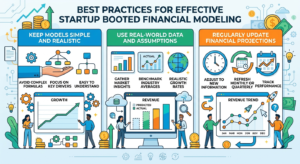
Strong financial modeling improves startup performance. Accurate planning supports better decision-making. Business stability increases through structured forecasting. Growth becomes more controlled and predictable.
Keep models simple and realistic
Simple financial structures improve clarity and make analysis easier. Overly complex models increase the chances of errors and confusion. Practical and realistic design improves overall forecasting accuracy.
Use real-world data and assumptions
Market research strengthens financial reliability and decision quality. Real data reduces forecasting errors and unrealistic projections. Business planning becomes more stable and effective with accurate inputs.
Regularly update financial projections
Continuous updates ensure financial models stay accurate and relevant. Business changes are reflected quickly in projections and forecasts. Decision-making improves significantly with updated financial insights.
Real Impact of Startup Booted Financial Modeling Success
Financial modeling significantly improves overall business outcomes and performance. Strategic planning becomes more accurate, structured, and efficient for startups. Financial risks are reduced through proper forecasting and data-driven analysis. Business growth becomes faster, more stable, and better organized. Startups gain stronger control over decisions, planning, and long-term success.
Better strategic decision-making
Business choices become fully data-driven instead of guesswork. The risk of making wrong financial or operational decisions decreases significantly. Overall operational efficiency improves with clear financial insights.
Reduced financial risks
Early identification of financial risks becomes possible through forecasting. Preventive strategies help maintain stronger business stability over time. Long-term financial losses reduce due to better planning and control.
Faster business growth trajectory
Business execution becomes more structured, focused, and efficient. Scaling decisions become safer with clear financial visibility. Overall growth speed increases with improved planning and execution.
Final Thoughts
Startup booted financial modeling plays a critical role in modern business success. Structured financial planning transforms uncertainty into clear business direction. Better decision-making improves overall business performance and efficiency. Sustainable growth becomes achievable through proper financial strategy execution. Strong financial models help startups stay prepared for risks and opportunities. Overall, financial modeling acts as a foundation for long-term business stability and growth.
Pingback: How to Be Better at Interior Design MintPalDecor with Simple Techniques