
Satellite swarms are emerging as one of the most important developments in modern space technology. These systems involve large groups of small satellites working together as a coordinated network rather than operating individually. This approach improves coverage, flexibility, and resilience in space operations. In recent years, discussions around China satellite swarms concerns have increased in global security and defense circles.
Space is no longer only a scientific domain. It has become closely tied to communication systems, navigation, defense operations, and global economic stability. As a result, any major advancement in satellite systems naturally draws international attention.
What Are Satellite Swarms?
Satellite swarms are large groups of small satellites that operate together as a unified system. Instead of functioning independently, these satellites share data and coordinate tasks to achieve a common objective such as Earth observation, communication, or navigation support.
How Satellite Swarms Work in Space Networks
China Satellite Swarms Concerns rely on inter-satellite communication, allowing satellites to exchange information directly in orbit. This reduces dependency on ground stations and improves response speed and efficiency.
Many modern swarm systems also use automation or artificial intelligence to manage positioning, coordination, and data distribution. This makes the system more adaptive and less vulnerable to single-point failures.
Difference Between Traditional Satellites and Swarms
Traditional satellites are typically large, expensive, and operate individually or in small groups. If one fails, it can significantly affect the mission.
In contrast, satellite swarms:
- Use many small satellites instead of a few large ones
- Operate as a coordinated network
- Provide higher redundancy and reliability
- Can be deployed more quickly and updated more easily
China’s Growing Space Capabilities
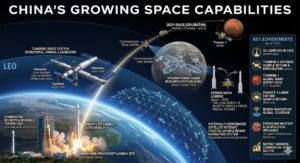
China has developed one of the fastest-growing space programs in the world. Managed by the China National Space Administration, China Satellite Swarms Concerns has achieved major milestones such as the Tiangong Space Station, lunar exploration missions, and a large satellite navigation system known as BeiDou.
These developments show China’s strong focus on expanding its presence in space across scientific, commercial, and strategic areas.
Recent Developments in Satellite Deployment
China has significantly increased satellite launches in recent years, including small satellites and experimental network-based systems. These developments reflect a global trend toward building large-scale satellite constellations.
Although many satellites are designed for civilian use such as communication and Earth observation, the underlying technology can also support strategic and defense-related functions.
Focus on Military and Communication Applications
Like other major space powers, China’s space infrastructure supports both civilian and military applications. Satellite systems can provide secure communication channels, navigation support, and real-time Earth monitoring.
This dual-use nature is one of the key reasons why China satellite swarms concerns are frequently discussed in international security analysis.
Why China Satellite Swarms Are Raising Concerns
One of the main concerns is the ability of large satellite networks to collect frequent and high-resolution data about the Earth’s surface. This capability can enhance surveillance, monitoring, and intelligence gathering.
China Satellite Swarms Concerns grow more advanced, they may significantly improve real-time observation capabilities.
Potential Military Uses in Conflict Scenarios
Satellite swarms can improve communication resilience and operational coordination during conflicts. Because the network is distributed across many satellites, it is harder to disable completely compared to single-satellite systems.
This resilience makes satellite swarms strategically important for defense communication and battlefield coordination.
Impact on Space Dominance and Power Balance
Space is increasingly viewed as a domain of strategic competition. Countries with advanced satellite systems gain advantages in navigation, communication, and intelligence capabilities.
China’s expansion in this area contributes to shifting global space dynamics, prompting other nations to strengthen their own satellite networks and defense systems.
Global Security Implications
China Satellite Swarms Concerns modern societies depend heavily on satellites for communication, weather forecasting, financial systems, and military operations. Any disruption to these systems can have widespread consequences.
As satellite networks expand, concerns increase about congestion in orbit and the vulnerability of space infrastructure.
Space as a New Battlefield
Many countries now treat space as a strategic domain alongside land, air, sea, and cyber space. While international agreements promote peaceful use of space, military planning increasingly includes space-based assets as critical infrastructure.
Cybersecurity and Signal Interference Risks
China Satellite Swarms Concerns systems depend on secure communication links. Risks include signal jamming, cyber intrusions, and interference with data transmission.
As satellite swarms become more complex, protecting them from cyber and electronic threats becomes more challenging.
How Other Countries Are Responding
- United States Space Strategy: The United States has established the U.S. Space Force to protect its space assets and maintain operational security in orbit. It also invests heavily in satellite constellations for communication and defense purposes.
- NATO and Allied Space Initiatives: NATO has recognized space as an operational domain and is increasing cooperation among member countries for satellite monitoring, intelligence sharing, and defense coordination in space-related activities.
- International Space Regulations and Agreements: Existing space laws, such as the Outer Space Treaty, promote peaceful use of space. However, these frameworks were created decades ago and are often considered insufficient for modern satellite technologies.
Future of Satellite Swarm Technology

China Satellite Swarms Concerns are expected to rely more on artificial intelligence for coordination, decision-making, and system optimization. This will allow satellites to operate more independently and efficiently.
Commercial vs Military Space Use
Satellite swarms are used for both commercial and defense purposes. Commercial applications include internet connectivity, climate monitoring, and global communication services, while military applications focus on security, surveillance, and communication resilience.
What the Next 10 Years Might Look Like
Over the next decade, satellite swarms are expected to expand significantly. This may include thousands of satellites operating in coordinated networks, increased automation in space systems, and stronger international competition in satellite infrastructure.
Conclusion
The topic of China satellite swarms concerns reflects a broader transformation in global space technology and security. Satellite swarms offer major advantages in communication, observation, and resilience, but they also raise important strategic questions.
The future of satellite swarm technology will depend on how countries balance innovation with responsible use and international cooperation. As space becomes increasingly crowded and strategically important, collaboration and regulation will be essential for maintaining global stability.
FAQs About China Satellite Swarms Concerns
What are satellite swarms?
Satellite swarms are groups of small satellites that work together as a coordinated network to perform shared tasks such as communication or Earth observation.
Why is China developing satellite swarms?
China is expanding satellite technology to improve communication systems, navigation, Earth observation, and strategic space capabilities.
Are satellite swarms a threat to global security?
They are not inherently a threat, but their dual-use potential for civilian and military applications raises strategic concerns among global powers.
How do satellite swarms work?
They operate through interconnected satellites that communicate and coordinate using advanced networking systems, sometimes supported by artificial intelligence.
Pingback: What is a Good Design Software GFXPixelment? Features, Tools & Tips Explained